3.1.10.8. Aggregator Section
- section Aggregator $secTag $matTag1 $code1 $matTag2 $code2 ... <-section $baseSecTag>
ops.section('Aggregator', secTag, matTag1, code1, matTag2, code2, ..., <'-section', baseSecTag>)
Argument |
Type |
Description |
|---|---|---|
$secTag |
integer |
unique section tag |
$matTag1 $code1 … |
list |
pairs of uniaxial material tag and the response code it is assigned to |
$baseSecTag |
integer |
tag of a previously defined section, to which the uniaxial materials are added (optional) |
Discussion
This command is used to construct a section by aggregating uniaxial materials, each giving the force-deformation response of one section response component, with an optional base section. The resulting response components are uncoupled from each other, but those of the base section keep their coupling. A common use is to add shear or torsion to a fiber section, whose response components are P, Mz and My.
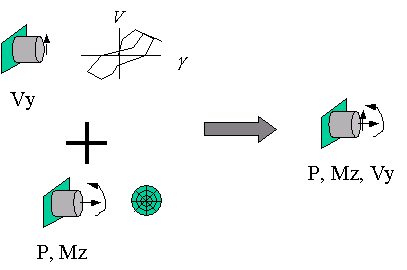
Fig. 3.1.10.6 Section aggregator
The response codes are P (axial force), Mz (moment about the local z axis), My (moment about the local y axis), Vy (shear along y), Vz (shear along z) and T (torsion).
Note
The materials relate a section force and deformation, e.g. moment and curvature, so their parameters must be given in those terms.
A code cannot be given twice, including a code of the base section.
AddDeformation is another name for this section.
Example:
The following example adds an elastic torsion material, 5, to the fiber section 1.
section Aggregator 2 5 T -section 1
ops.section('Aggregator', 2, 5, 'T', '-section', 1)
Code Developed by: Michael H. Scott