3.1.3.60. ElastomericBearingBouc-Wen Element
This command is used to construct an elastomericBearing element object, which is defined by two nodes. The element can have zero length or the appropriate bearing height. The bearing has unidirectional (2D) or coupled (3D) plasticity properties for the shear deformations, using a Bouc-Wen hysteretic model, and force-deformation behaviors defined by UniaxialMaterials in the remaining two (2D) or four (3D) directions. By default (sDratio = 0.5) P-Delta moments are equally distributed to the two end-nodes. To avoid the introduction of artificial viscous damping in the isolation system (sometimes referred to as “damping leakage in the isolation system”), the bearing element does not contribute to the Rayleigh damping by default. If the element has non-zero length, the local x-axis is determined from the nodal geometry unless the optional x-axis vector is specified in which case the nodal geometry is ignored and the user-defined orientation is utilized. In Tcl the command name elastomericBearingBW is an alias for elastomericBearingBoucWen.
For a two-dimensional problem:
- element elastomericBearingBoucWen $eleTag $iNode $jNode $kInit $qd $alpha1 $alpha2 $mu $eta $beta $gamma -P $matTag -Mz $matTag <-orient $x1 $x2 $x3 $y1 $y2 $y3> <-shearDist $sDratio> <-doRayleigh> <-mass $m> <-iter $maxIter $tol>
For a three-dimensional problem:
- element elastomericBearingBoucWen $eleTag $iNode $jNode $kInit $qd $alpha1 $alpha2 $mu $eta $beta $gamma -P $matTag -T $matTag -My $matTag -Mz $matTag <-orient <$x1 $x2 $x3> $y1 $y2 $y3> <-shearDist $sDratio> <-doRayleigh> <-mass $m> <-iter $maxIter $tol>
For a two-dimensional problem:
ops.element('elastomericBearingBoucWen', eleTag, iNode, jNode, kInit, qd, alpha1, alpha2, mu, eta, beta, gamma, '-P', matTag, '-Mz', matTag, <'-orient', x1, x2, x3, y1, y2, y3>, <'-shearDist', sDratio>, <'-doRayleigh'>, <'-mass', m>, <'-iter', maxIter, tol>)
For a three-dimensional problem:
ops.element('elastomericBearingBoucWen', eleTag, iNode, jNode, kInit, qd, alpha1, alpha2, mu, eta, beta, gamma, '-P', matTag, '-T', matTag, '-My', matTag, '-Mz', matTag, <'-orient', <x1, x2, x3>, y1, y2, y3>, <'-shearDist', sDratio>, <'-doRayleigh'>, <'-mass', m>, <'-iter', maxIter, tol>)
Argument |
Type |
Description |
|---|---|---|
$eleTag |
integer |
unique element object tag |
$iNode $jNode |
2 integer |
end nodes |
$kInit |
float |
initial elastic stiffness in local shear direction |
$qd |
float |
characteristic strength |
$alpha1 |
float |
post yield stiffness ratio of linear hardening component |
$alpha2 |
float |
post yield stiffness ratio of non-linear hardening component |
$mu |
float |
exponent of non-linear hardening component |
$eta |
float |
yielding exponent (sharpness of hysteresis loop corners) (typical value = 1.0) |
$beta |
float |
first hysteretic shape parameter (typical value = 0.5) |
$gamma |
float |
second hysteretic shape parameter (typical value = 0.5) |
-P $matTag |
integer |
tag associated with previously-defined UniaxialMaterial in axial direction |
-T $matTag |
integer |
tag associated with previously-defined UniaxialMaterial in torsional direction (3D only) |
-My $matTag |
integer |
tag associated with previously-defined UniaxialMaterial in moment direction around local y-axis (3D only) |
-Mz $matTag |
integer |
tag associated with previously-defined UniaxialMaterial in moment direction around local z-axis |
$x1 $x2 $x3 |
list float |
vector components in global coordinates defining local x-axis (optional) |
$y1 $y2 $y3 |
list float |
vector components in global coordinates defining local y-axis (optional) |
$sDratio |
float |
shear distance from iNode as a fraction of the element length (optional: default = 0.5) |
-doRayleigh |
string |
to include Rayleigh damping from the bearing (optional: default = no Rayleigh damping contribution) |
$m |
float |
element mass (optional: default = 0.0) |
$maxIter |
integer |
maximum number of iterations to solve the Bouc-Wen evolution equation (optional: default = 25) |
$tol |
float |
convergence tolerance for the Bouc-Wen evolution equation (optional: default = 1E-12) |
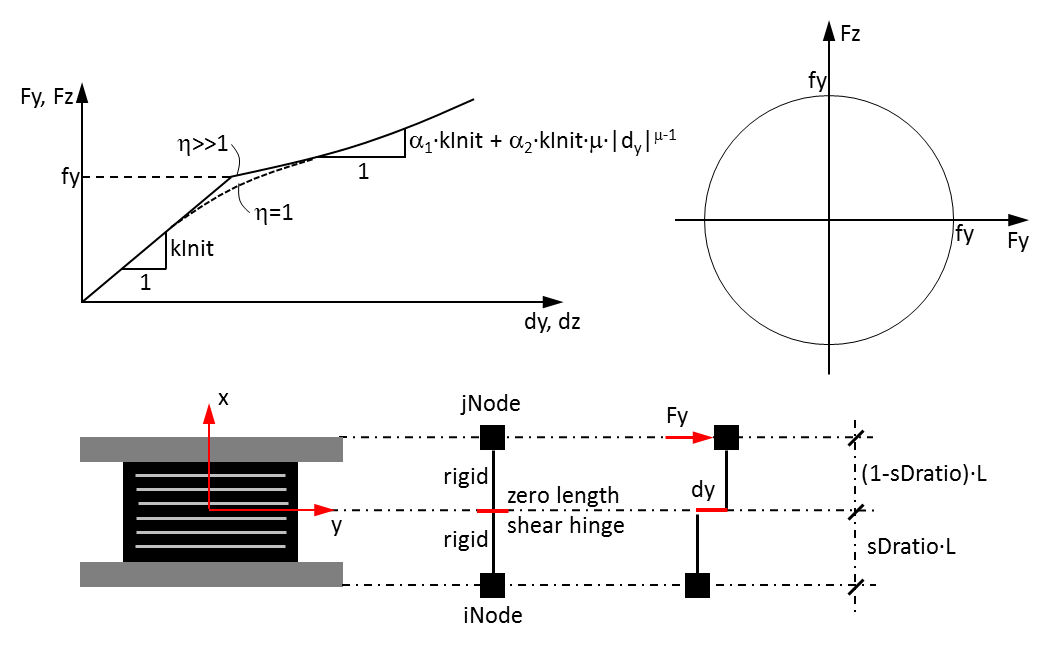
Fig. 3.1.3.35 ElastomericBearingBoucWen element: shear force-deformation behavior, coupled 3D yield surface, and element geometry
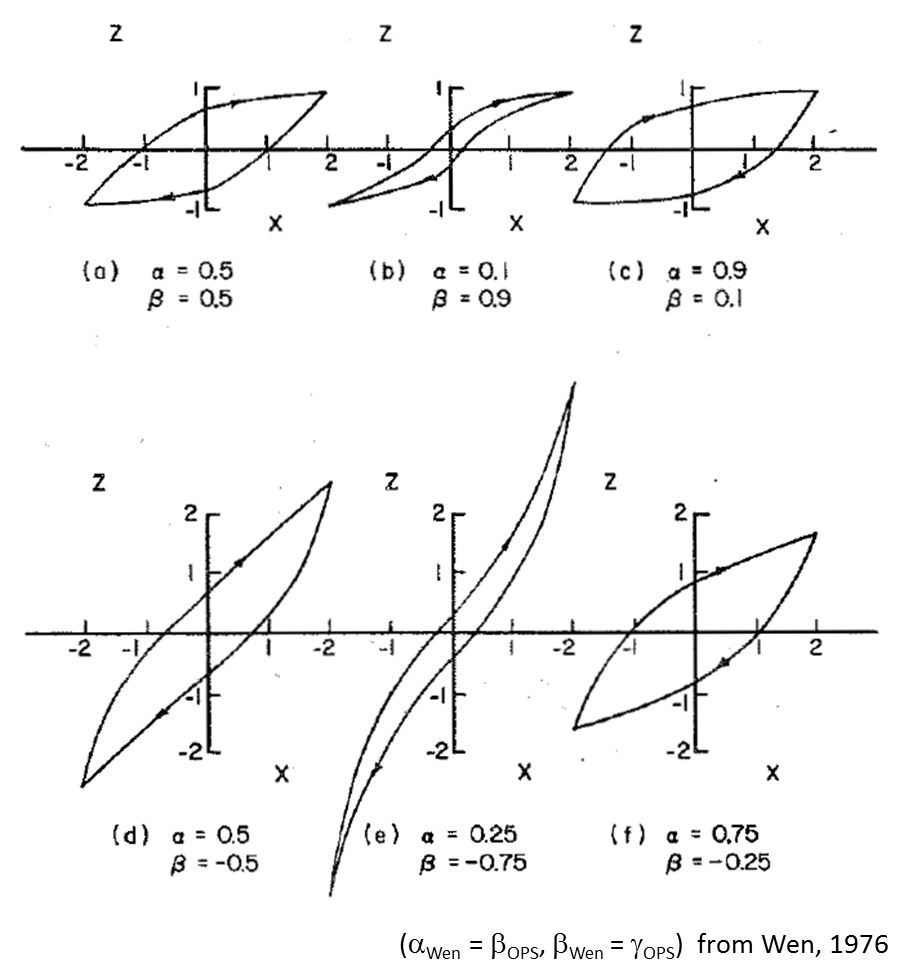
Fig. 3.1.3.36 Effect of the hysteretic shape parameters on the Bouc-Wen loops (from Wen, 1976; \(\alpha_{Wen} = \beta\), \(\beta_{Wen} = \gamma\))
Note
If the element has zero length and optional orientation vectors are not specified, the local element axes coincide with the global axes. Otherwise the local z-axis is defined by the cross product between the x- and y-vectors specified on the command line.
The bearing is stiff in compression but not rigid. Using unrealistically large values (e.g. 1E10) for the axial stiffness can lead to numerical problems, so a realistic axial stiffness should be specified.
Valid queries to the elastomericBearingBoucWen element when creating an Element Recorder are
force(orglobalForce),localForce,basicForce,localDisplacement,basicDisplacement(orbasicDeformation),hystereticParameter(the Bouc-Wen hysteretic variable z),dzdu,basicStiffness, andmaterial $matNum matArg1 matArg2 ..., where$matNumis the number (1 to 2 in 2D, 1 to 4 in 3D, in the order the materials appear in the command) of the material whose data is to be output.
Example
Tcl Code
# 2D elastomeric bearing
element elastomericBearingBoucWen 1 1 2 20.0 2.50 0.02 0.0 3.0 1.0 0.5 0.5 -P 1 -Mz 2

# 3D elastomeric bearing
element elastomericBearingBoucWen 1 1 2 20.0 2.50 0.02 0.0 3.0 1.0 0.5 0.5 -P 1 -T 2 -My 3 -Mz 4
Python Code
# 2D elastomeric bearing
ops.element('elastomericBearingBoucWen', 1, 1, 2, 20.0, 2.50, 0.02, 0.0, 3.0, 1.0, 0.5, 0.5, '-P', 1, '-Mz', 2)

# 3D elastomeric bearing
ops.element('elastomericBearingBoucWen', 1, 1, 2, 20.0, 2.50, 0.02, 0.0, 3.0, 1.0, 0.5, 0.5, '-P', 1, '-T', 2, '-My', 3, '-Mz', 4)
Code Developed by: Andreas Schellenberg at University of California, Berkeley.