3.1.3.80. SSPquadUP Element
This command is used to construct a SSPquadUP element object. The SSPquadUP element is an extension of the SSPquad Element element for use in dynamic plane strain analysis of fluid saturated porous media. A mixed displacement-pressure (u-p) formulation is used, based upon the work of Biot as extended by [ZienkiewiczShiomi1984]. Use with -ndm 2 -ndf 3: degrees of freedom 1 and 2 are the solid displacements and degree of freedom 3 is the pore pressure.
The physical stabilization necessary to allow for reduced integration incorporates an assumed strain field in which the volumetric dilation and the shear strain associated with the hourglass modes are zero, resulting in an element which is free from volumetric and shear locking. The elimination of shear locking results in greater coarse mesh accuracy in bending dominated problems, and the elimination of volumetric locking improves accuracy in nearly-incompressible problems. Analysis times are generally faster than corresponding full integration elements.
Equal-order interpolation is used for the displacement and pressure fields, thus the SSPquadUP element does not inherently pass the inf-sup condition, and is not fully acceptable in the incompressible-impermeable limit (the FourNodeQuadUP Element element has the same issue). A stabilizing parameter, $alpha, is employed to permit the use of equal-order interpolation. The element is described in [McGannEtAl2012].
- element SSPquadUP $eleTag $iNode $jNode $kNode $lNode $matTag $thick $fBulk $fDen $k1 $k2 $void $alpha <$b1 $b2> <$Pup $Plow $Pleft $Pright>
ops.element('SSPquadUP', eleTag, iNode, jNode, kNode, lNode, matTag, thick, fBulk, fDen, k1, k2, void, alpha, <b1, b2>, <Pup, Plow, Pleft, Pright>)
Argument |
Type |
Description |
|---|---|---|
$eleTag |
integer |
unique element tag |
$iNode $jNode $kNode $lNode |
4 integer |
the four nodes defining the element in counterclockwise order |
$matTag |
integer |
tag of a previously defined nDMaterial |
$thick |
float |
thickness of the element in the out-of-plane direction |
$fBulk |
float |
bulk modulus of the pore fluid |
$fDen |
float |
mass density of the pore fluid |
$k1 $k2 |
float |
permeability coefficients in the global x- and y-directions |
$void |
float |
void ratio |
$alpha |
float |
spatial pressure field stabilization parameter (see below) |
$b1 $b2 |
float |
constant body forces in the global x- and y-directions (optional: default = 0.0) |
$Pup $Plow $Pleft $Pright |
float |
constant surface pressures on the upper (nodes 3-4) lower (nodes 1-2) left (nodes 4-1) and right (nodes 2-3) sides of the element (optional: default = 0.0). If given then |
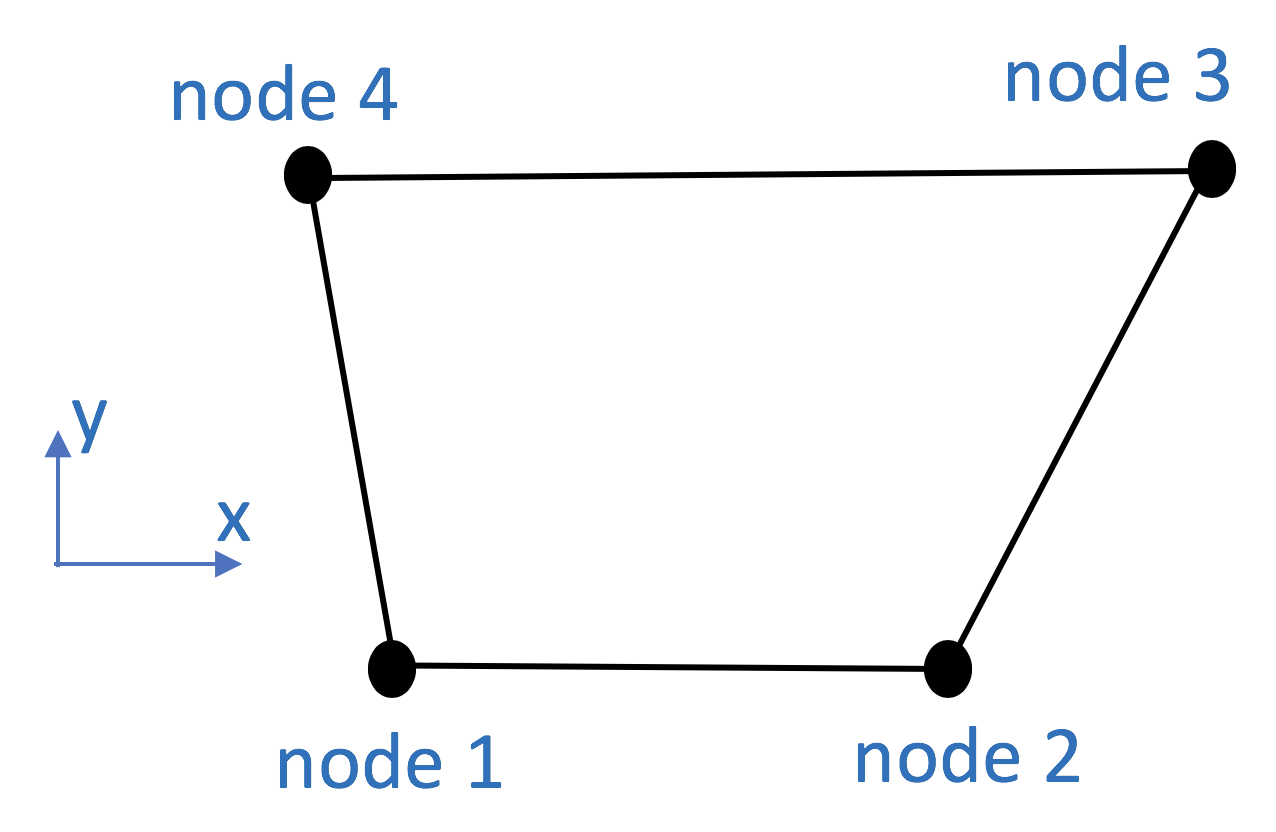
Fig. 3.1.3.66 SSPquadUP Element Node Numbering
Stabilization parameter
The stabilization parameter $alpha should be a small number. It can be computed for each element as
where \(h\) is the element size, \(c\) is the speed of elastic wave propagation in the solid phase, and \(\rho\) is the mass density of the solid phase.
Note
The SSPquadUP element will only work in dynamic analysis.
For saturated soils, the mass density input into the associated nDMaterial object should be the saturated mass density.
When modeling soil, the body forces input into the SSPquadUP element should be the components of the gravitational vector, not the unit weight. If an
eleLoad -type -selfWeight $xFactor $yFactoris applied to the element in a load pattern, the body forces are instead taken as$b1and$b2scaled by these factors and the load factor.Fixing the pore pressure degree of freedom (dof 3) at a node is a drainage boundary condition at which zero pore pressure will be maintained throughout the analysis. Leaving the third dof free allows pore pressures to build at that node.
The surface pressures
$Pup $Plow $Pleft $Prightare applied at all times, independent of any load pattern. A positive value acts in the direction of the outward normal of the side, so a compressive surface load is entered as a negative value.Valid queries to the SSPquadUP element when creating an Element Recorder are
stress2D3andstrain2D3, which return the three in-plane components, plus those of the nDMaterial object assigned to the element (e.g.,stress,strain). Material response is recorded at the single integration point located in the center of the element.The following element parameters can be changed during an analysis with the
parameterandupdateParametercommands:hPermandvPerm(the permeabilities$k1and$k2),b1andb2, andpressureUpperSide,pressureLowerSide,pressureLeftSideandpressureRightSide. Other parameter names are passed on to the nDMaterial.The SSPquadUP element was designed with intentions of duplicating the functionality of the FourNodeQuadUP Element element. If an example is found where the SSPquadUP element cannot do something that works for the QuadUP element, e.g., material updating, please contact the developers listed below so the bug can be fixed.
Example
SSPquadUP element definition with element tag 1, nodes 1, 2, 3, and 4, material tag 1, unit thickness, bulk modulus of water in kPa, mass density of water in Mg/m3, permeabilities of 1.0e-3, void ratio of 0.7, alpha of 6.0e-5, and gravitational body forces. Recorders are created for the element stress and strain and for the nodal pore pressures (dof 3).
Tcl Code
element SSPquadUP 1  1 2 3 4  1 1.0 2.2e6 1.0 1.0e-3 1.0e-3 0.7 6.0e-5 0.0 -9.81

recorder Element -eleRange 1 $numElem -time -file stress.out stress
recorder Element -eleRange 1 $numElem -time -file strain.out strain
recorder Node -nodeRange 1 $numNode -time -file porePressure.out -dof 3 vel
Python Code
ops.element('SSPquadUP', 1, 1, 2, 3, 4, 1, 1.0, 2.2e6, 1.0, 1.0e-3, 1.0e-3, 0.7, 6.0e-5, 0.0, -9.81)

ops.recorder('Element', '-eleRange', 1, numElem, '-time', '-file', 'stress.out', 'stress')
ops.recorder('Element', '-eleRange', 1, numElem, '-time', '-file', 'strain.out', 'strain')
ops.recorder('Node', '-nodeRange', 1, numNode, '-time', '-file', 'porePressure.out', '-dof', 3, 'vel')
The pore pressure is recorded with the vel response because the u-p formulation in OpenSees stores the pore pressure at dof 3 in the nodal velocity vector.
Code Developed by: Chris McGann, Pedro Arduino, Peter Mackenzie-Helnwein at University of Washington.
Zienkiewicz, O.C. and Shiomi, T. (1984). “Dynamic behavior of saturated porous media; the generalized Biot formulation and its numerical solution.” International Journal for Numerical Methods in Geomechanics, 8, 71-96.