3.1.3.13. Truss2 and CorotTruss2 Elements
These commands are used to construct a Truss2 or CorotTruss2 element, a truss element that also measures the strain normal to it, through a zero-stiffness gauge element, so that a uniaxial material can account for biaxial effects.
- element Truss2 $eleTag $iNode $jNode $mGNode $nGNode $A $matTag <-rho $rho> <-doRayleigh $rFlag>
- element CorotTruss2 $eleTag $iNode $jNode $mGNode $nGNode $A $matTag <-rho $rho>
ops.element('Truss2', eleTag, iNode, jNode, mGNode, nGNode, A, matTag, <'-rho', rho>, <'-doRayleigh', rFlag>)
ops.element('CorotTruss2', eleTag, iNode, jNode, mGNode, nGNode, A, matTag, <'-rho', rho>)
Argument |
Type |
Description |
|---|---|---|
$eleTag |
integer |
unique element object tag |
$iNode $jNode |
integer |
end nodes of the truss |
$mGNode $nGNode |
integer |
end nodes of the zero-stiffness gauge element |
$A |
float |
cross-sectional area of the truss |
$matTag |
integer |
tag of a previously defined uniaxial material |
$rho |
float |
mass per unit length (optional: default = 0.0) |
$rFlag |
integer |
Rayleigh damping flag, Truss2 only (optional: default = 0): 0 no Rayleigh damping, 1 include Rayleigh damping |
Discussion
The element is made of a truss element, from $iNode to $jNode, which behaves as the Truss element (or the corotTruss element for CorotTruss2), and a zero-stiffness gauge element, from $mGNode to $nGNode, which measures the strain in its direction (Figure 1). The strain normal to the truss, \(\varepsilon_n\), is computed from the strain of the truss, \(\varepsilon_{truss}\), the strain of the gauge, \(\varepsilon_{gauge}\), and the angle between them, \(\theta_g\), with Equation 1. The angle \(\theta_g\) should be as close to 90° as possible.
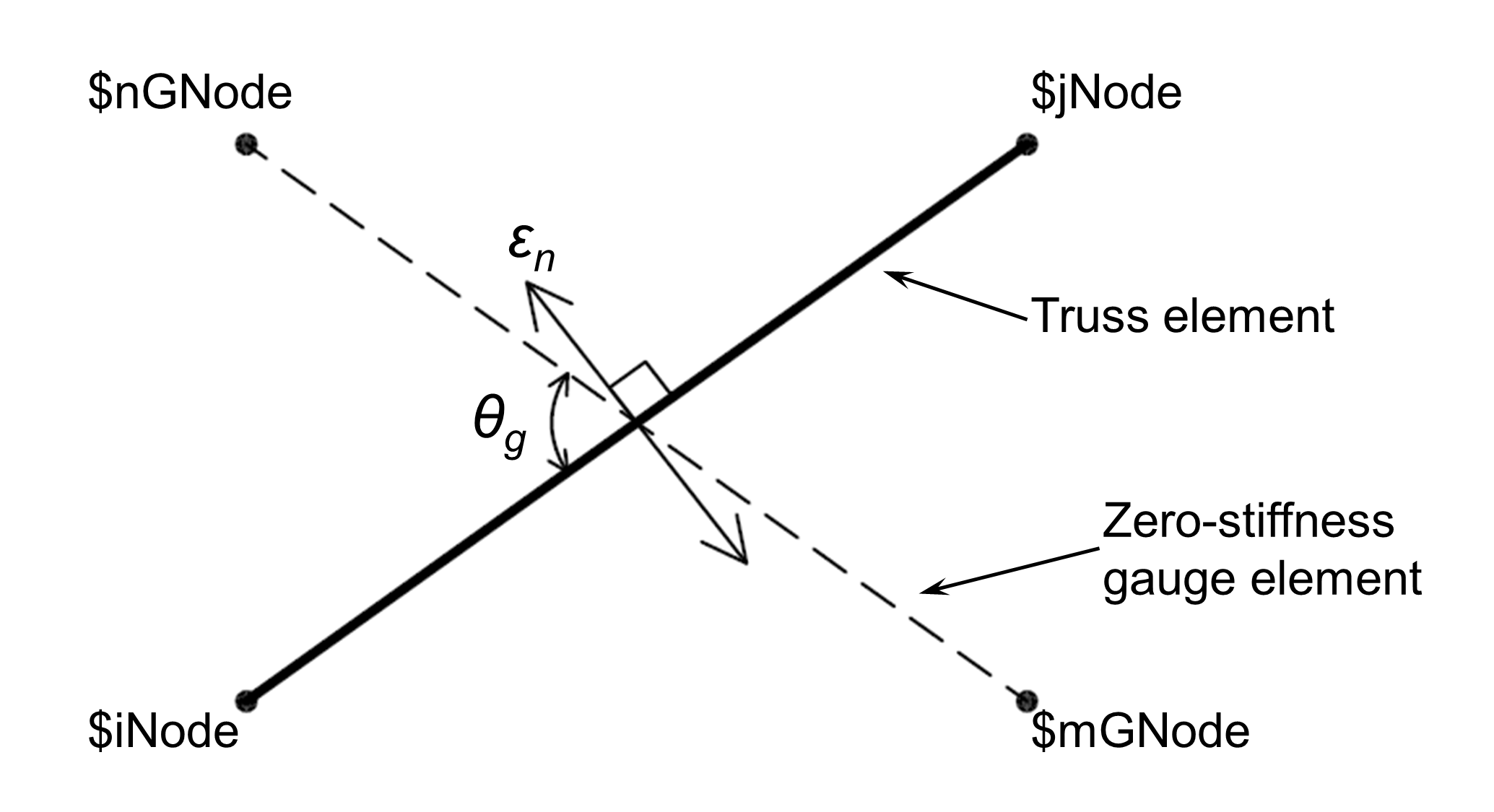
Fig. 3.1.3.2 Figure 1. Layout of the truss and the zero-stiffness gauge element, from the input nodes
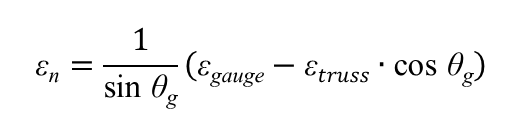
Fig. 3.1.3.3 Equation 1. Strain normal to the truss
The elements are designed for use with the ConcretewBeta uniaxial material, to account for biaxial effects in the concrete struts of truss models of reinforced concrete walls [1] [2]: the normal strain is passed to that material. With a material that does not use biaxial effects, the elements behave as their uniaxial counterparts, Truss and corotTruss.
Note
As the Truss element, Truss2 includes Rayleigh damping only with
-doRayleigh 1. As the corotTruss element, CorotTruss2 always includes Rayleigh damping, and has no-doRayleighoption.There is no section (trussSection) version of these elements.
The valid element recorder queries are those of the Truss element, e.g. axialForce, basicDeformation and material $arg1 ….
Example
The following example defines a Truss2 element between nodes 1 and 2, with the gauge element between nodes 3 and 4, an area of 10.0 and the uniaxial material 1.
element Truss2 1 1 2 3 4 10.0 1
ops.element('Truss2', 1, 1, 2, 3, 4, 10.0, 1)
Code Developed by: Yuan Lu and Marios Panagiotou, UC Berkeley