3.1.3.101. MasonPan12 Element
This command is used to construct a twelve-node masonry panel element, which represents a masonry infill panel with six diagonal struts, three in each direction.
- element MasonPan12 $eleTag $node1 $node2 ... $node12 $matTag1 $matTag2 $thick $wTot $w1
ops.element('MasonPan12', eleTag, node1, node2, ..., node12, matTag1, matTag2, thick, wTot, w1)
Argument |
Type |
Description |
|---|---|---|
$eleTag |
integer |
unique element object tag |
$node1 … $node12 |
12 integer |
the twelve nodes of the panel, counter-clockwise starting from the bottom left corner (Figure 1) |
$matTag1 |
integer |
tag of the uniaxial material of the central struts |
$matTag2 |
integer |
tag of the uniaxial material of the lateral struts |
$thick |
float |
out-of-plane thickness of the panel |
$wTot |
float |
ratio of the total strut width to the diagonal length of the panel |
$w1 |
float |
ratio of the central strut width to the total strut width |
Discussion
The element captures the nonlinear behavior of a masonry panel loaded diagonally, in which the main crack is diagonal [1]. The six struts (D1 to D6 in Figure 1) allow the panel to carry axial forces after the central struts have degraded due to cracking, and the lateral struts interact with the surrounding frame, introducing shear forces and bending moments in the columns and beams near the joints. The Masonry uniaxial material is intended for the struts.
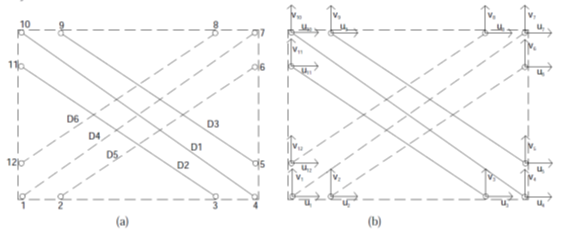
Fig. 3.1.3.77 Figure 1. MasonPan12 element: (a) nodes and struts; (b) degrees of freedom
Note
The element is two-dimensional, for a model with
-ndm 2 -ndf 3(36 degrees of freedom). The corner nodes, 1, 4, 7 and 10, are those of the surrounding frame; the other nodes are on the beams and columns, at the ends of the lateral struts.The valid element recorder queries are force (global forces), deformation, basicForce, basicDeformation, shear and material $i $arg1 ….
Example
The following example defines a panel with nodes 1 to 12, the strut materials 1 and 2, a thickness of 0.2, a total strut width ratio of 0.25, and a central strut width ratio of 0.5.
element MasonPan12 1 1 2 3 4 5 6 7 8 9 10 11 12 1 2 0.2 0.25 0.5
ops.element('MasonPan12', 1, *range(1, 13), 1, 2, 0.2, 0.25, 0.5)
Code Developed by: Gonzalo Torrisi, Universidad Nacional de Cuyo, Mendoza, Argentina