3.1.3.50. Twenty Node Brick Element
This command is used to construct a twenty-node, quadratic, three-dimensional brick element.
- element 20NodeBrick $eleTag $node1 $node2 ... $node20 $matTag <$b1 $b2 $b3>
ops.element('20NodeBrick', eleTag, node1, node2, ..., node20, matTag, <b1, b2, b3>)
Argument |
Type |
Description |
|---|---|---|
$eleTag |
integer |
unique element object tag |
$node1 … $node20 |
20 integer |
the twenty nodes of the element, in the order shown in the figure below |
$matTag |
integer |
tag of a previously defined three-dimensional nDMaterial |
$b1 $b2 $b3 |
float |
body forces in the global x, y and z directions (optional: default = 0.0) |
Discussion
The element uses quadratic shape functions and 27-point (3x3x3) Gauss integration. It must be used in a model with -ndm 3 -ndf 3.
The nodes are numbered as in the figure: first the 8 corner nodes, 1 to 4 on the bottom face (\(t = -1\)) and 5 to 8 on the top face (\(t = 1\)), both counter-clockwise; then the 8 mid-edge nodes of the bottom face (9 to 12, node 9 between nodes 1 and 2) and of the top face (13 to 16, node 13 between nodes 5 and 6); and last the 4 mid-edge nodes of the vertical edges (17 to 20, node 17 between nodes 1 and 5).
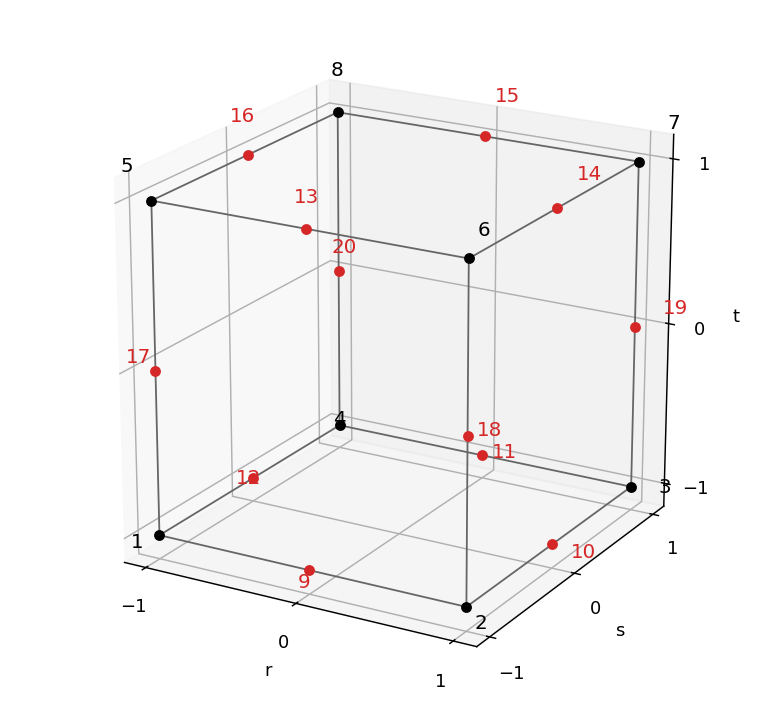
Fig. 3.1.3.26 Node numbering of the 20NodeBrick element in its local coordinates (corner nodes in black, mid-edge nodes in red)
Note
The mass matrix is computed from the mass density of the nDMaterial; the element has no mass density argument (the massDen argument given in some versions of the OpenSeesPy documentation does not exist).
The valid element recorder queries are force, stresses, which gives the six stress components \(\sigma_{xx}, \sigma_{yy}, \sigma_{zz}, \sigma_{xy}, \sigma_{yz}, \sigma_{zx}\) at each of the 27 Gauss points, and material $i $arg1 …, the response of the material at Gauss point $i.
Example
The following example defines a 20-node brick of unit size, with the elastic material 1.
model basic -ndm 3 -ndf 3
nDMaterial ElasticIsotropic 1 30000.0 0.2 0.0024
# corner nodes
node 1 0 0 0; node 2 1 0 0; node 3 1 1 0; node 4 0 1 0
node 5 0 0 1; node 6 1 0 1; node 7 1 1 1; node 8 0 1 1
# mid-edge nodes, bottom face, top face, vertical edges
node  9 0.5 0.0 0; node 10 1.0 0.5 0; node 11 0.5 1.0 0; node 12 0.0 0.5 0
node 13 0.5 0.0 1; node 14 1.0 0.5 1; node 15 0.5 1.0 1; node 16 0.0 0.5 1
node 17 0 0 0.5; node 18 1 0 0.5; node 19 1 1 0.5; node 20 0 1 0.5
element 20NodeBrick 1 1 2 3 4 5 6 7 8 9 10 11 12 13 14 15 16 17 18 19 20 1
ops.model('basic', '-ndm', 3, '-ndf', 3)
ops.nDMaterial('ElasticIsotropic', 1, 30000.0, 0.2, 0.0024)
coords = [(0,0,0), (1,0,0), (1,1,0), (0,1,0), (0,0,1), (1,0,1), (1,1,1), (0,1,1),
          (0.5,0,0), (1,0.5,0), (0.5,1,0), (0,0.5,0), (0.5,0,1), (1,0.5,1), (0.5,1,1), (0,0.5,1),
          (0,0,0.5), (1,0,0.5), (1,1,0.5), (0,1,0.5)]
for i, xyz in enumerate(coords):
    ops.node(i+1, *xyz)
ops.element('20NodeBrick', 1, *range(1, 21), 1)
Code Developed by: Jinchi Lu and Zhaohui Yang, UC San Diego