3.1.8.77. BWBN Material
- uniaxialMaterial BWBN $matTag $alpha $ko $n $gamma $beta $Ao $q $zetas $p $Shi $deltaShi $lambda $tol $maxIter
ops.uniaxialMaterial('BWBN', matTag, alpha, ko, n, gamma, beta, Ao, q, zetas, p, Shi, deltaShi, lambda, tol, maxIter)
Argument |
Type |
Description |
|---|---|---|
$matTag |
integer |
unique uniaxial material tag |
$alpha |
float |
ratio of the post-yield to the initial stiffness, 0 < alpha < 1 |
$ko |
float |
initial elastic stiffness |
$n |
float |
parameter controlling the transition from linear to nonlinear response; the larger, the sharper (usually n >= 1) |
$gamma $beta |
float |
parameters controlling the shape of the hysteresis loop: softening, hardening or quasi-linear response (see BoucWen) |
$Ao |
float |
parameter controlling the tangent stiffness |
$q $zetas $p $Shi $deltaShi $lambda |
float |
parameters controlling the pinching |
$tol |
float |
tolerance of the iterations |
$maxIter |
integer |
maximum number of iterations |
Discussion
This command is used to construct a BWBN material, a Bouc-Wen model extended to include pinching, after Baber and Noori [1] and Foliente [2]. It has been used to model yielding shear panel devices (YSPD) [3] [4].
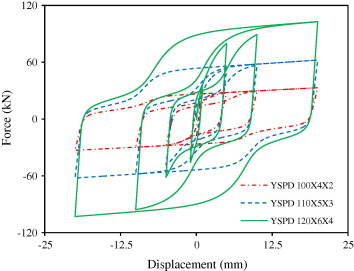
Fig. 3.1.8.82 Cyclic force-displacement response of yielding shear panel devices modeled with the BWBN material
Note
For the parameters that control the shape of the loop, see the notes of the BoucWen material.
Example:
The following example defines a BWBN material with an initial stiffness of 100.0 and a post-yield stiffness ratio of 0.05.
uniaxialMaterial BWBN 1 0.05 100.0 2.0 0.5 0.5 1.0 0.1 0.9 1.0 0.1 0.01 0.5 1.0e-8 20
ops.uniaxialMaterial('BWBN', 1, 0.05, 100.0, 2.0, 0.5, 0.5, 1.0, 0.1, 0.9, 1.0, 0.1, 0.01, 0.5, 1.0e-8, 20)
Code Developed by: Raquib Hossain, University of Queensland and Bangladesh University of Engineering and Technology