3.1.8.17. ConfinedConcrete01 Material
- uniaxialMaterial ConfinedConcrete01 $matTag $secType $fpc $Ec (-epscu $epscu | -scott | -gamma $gamma) (-nu $nu | -varUB | -varNoUB) $L1 <$L2 <$L3>> $phis $S $fyh $Es0 $haRatio $mu $phiLon <-internal $phisi $Si $fyhi $Es0i $haRatioi $mui> <-wrap $cover $Am $Sw $fuil $Es0w> <-gravel> <-silica> <-tol $tol> <-maxNumIter $maxNumIter> <-epscuLimit $epscuLimit> <-stRatio $stRatio>
ops.uniaxialMaterial('ConfinedConcrete01', matTag, secType, fpc, Ec, '-epscu', epscu, '-nu', nu, L1, phis, S, fyh, Es0, haRatio, mu, phiLon, ...)
Argument |
Type |
Description |
|---|---|---|
$matTag |
integer |
unique uniaxial material tag |
$secType |
string |
transverse reinforcement configuration: S1, S2, S3, S4a, S4b, S5 (square), C (circular) or R (rectangular) (see note 1) |
$fpc |
float |
unconfined cylinder strength of the concrete |
$Ec |
float |
initial elastic modulus of the unconfined concrete |
-epscu $epscu |
float |
ultimate strain of the confined concrete (one of the three ultimate strain options is required) |
-scott |
string |
ultimate strain from Scott et al. (1982): 0.004 + 0.9 rhos fyh / 300 |
-gamma $gamma |
float |
ultimate strain at which the stress is $gamma times the peak confined strength (see note 2) |
-nu $nu |
float |
constant Poisson ratio (one of the three Poisson ratio options is required) |
-varUB |
string |
Poisson ratio varying with the axial strain (Braga et al. 2006), with an upper bound of 0.5 |
-varNoUB |
string |
Poisson ratio varying with the axial strain, with no upper bound |
$L1 <$L2 <$L3>> |
float |
dimensions of the core, to the centerline of the hoops (see note 3) |
$phis |
float |
diameter of the (external) hoops |
$S |
float |
spacing of the hoops |
$fyh |
float |
yield strength of the hoop steel |
$Es0 |
float |
elastic modulus of the hoop steel |
$haRatio |
float |
hardening ratio of the hoop steel |
$mu |
float |
ductility factor of the hoop steel |
$phiLon |
float |
diameter of the longitudinal bars |
-internal … |
float |
diameter, spacing, yield strength, modulus, hardening ratio and ductility factor of the internal transverse reinforcement (optional: default = those of the external hoops, for S2, S3, S4a, S4b and S5; also -internalT) |
-wrap … |
float |
FRP wrap: cover thickness from the outer hoops, total area of the FRP (layers x thickness x width), spacing (the width for continuous wraps), ultimate strength and elastic modulus (optional) |
-gravel |
string |
the aggregate is gravel (optional: default = crushed aggregate) |
-silica |
string |
the concrete contains silica fume (optional) |
-tol $tol |
float |
tolerance of the iterations (optional: default = 1.0e-6) |
-maxNumIter $maxNumIter |
integer |
maximum number of iterations (optional: default = 500) |
-epscuLimit $epscuLimit |
float |
limit of the ultimate strain, used with -gamma (optional: default = 0.05) |
-stRatio $stRatio |
float |
ratio of the in-situ to the cylinder strength of the unconfined concrete, 0 to 1 (optional: default = 1.0) |
Discussion
This command is used to construct a ConfinedConcrete01 material, the confined concrete model of Braga, Gigliotti and Laterza [1], as implemented by D’Amato [2] [3]. The model has no tensile strength, and degraded linear unloading and reloading, according to Karsan and Jirsa [4]. The envelope is computed with a nonlinear approach at each increment of axial strain, in which each confinement curve is given by the model of Attard and Setunge [5].
The confinement can be provided by transverse reinforcement (hoops or stirrups), by FRP wraps, or by both.
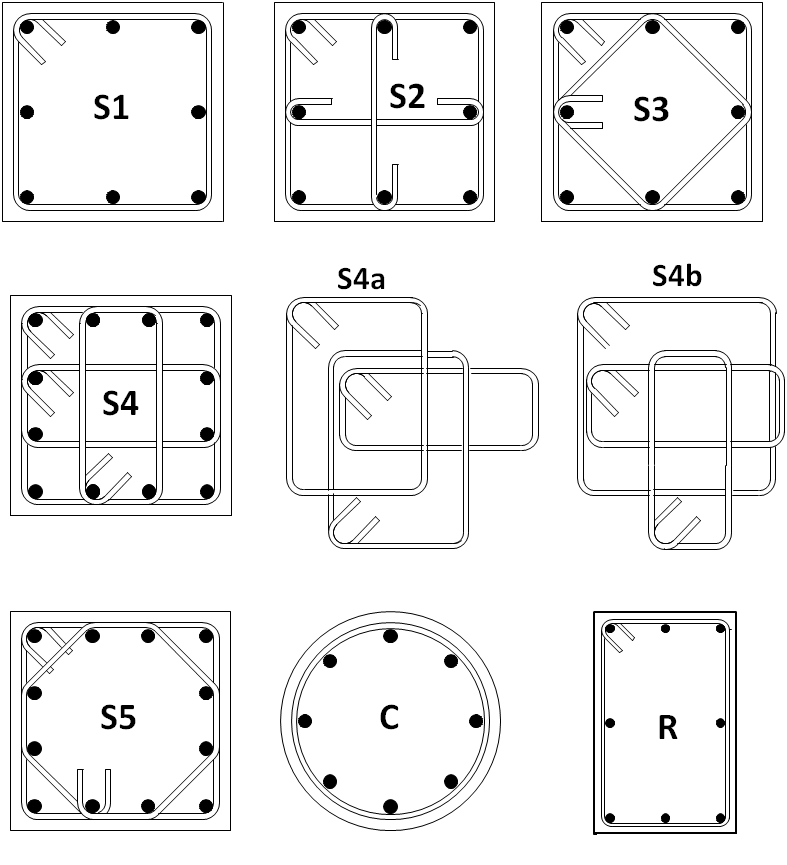
Fig. 3.1.8.36 Section types
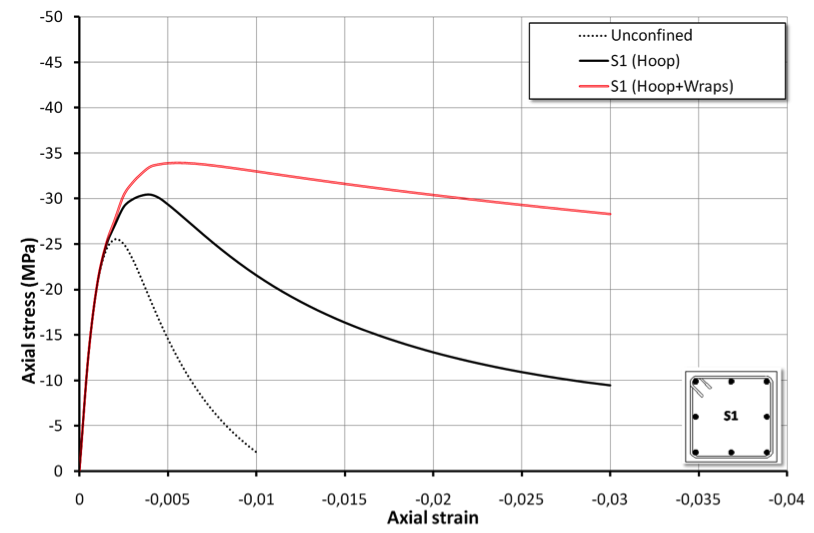
Fig. 3.1.8.37 Stress-strain response of section S1: unconfined, confined by hoops, and by hoops and FRP wraps
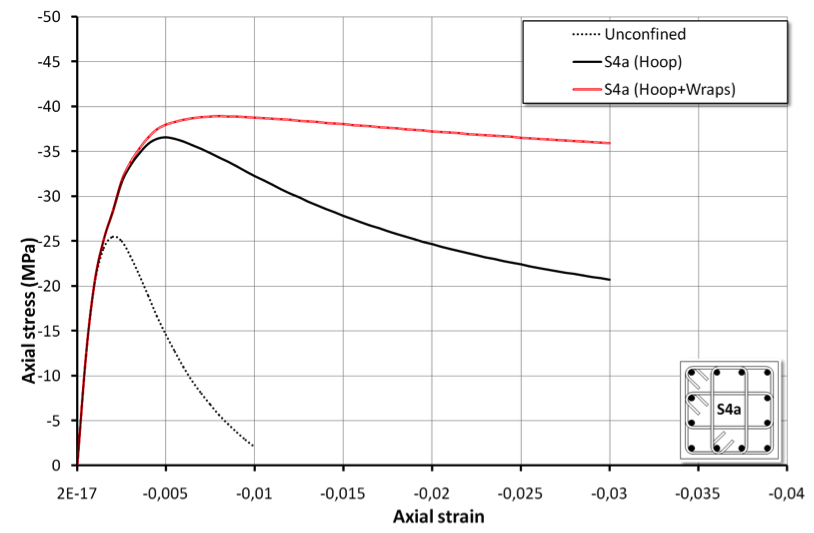
Fig. 3.1.8.38 Stress-strain response of section S4a
Note
Section types S1 to S5 are square sections with different transverse reinforcement configurations, with or without FRP wraps; C is circular, and R rectangular. See Fig. 8 of Braga et al. [1].
With -gamma, the ultimate strain is that at which the stress drops to \(\gamma\) times the peak confined strength. If this is not reached between 0 and $epscuLimit, the ultimate strain is $epscuLimit.
$L1 is the length (or diameter) of the core, to the centerline of the hoops; for rectangular sections, \(L_1 = 2d\). $L1, $L2 and $L3 are required for S4a and S4b, and $L1 and $L2 (\(2c\)) for R.
Stresses and strains can be given as positive or negative.
The examples on this page use MPa and mm.
Example:
The following example defines confined concrete materials for a square S1 section, a rectangular R section with an FRP wrap, and a circular section using the Scott ultimate strain.
uniaxialMaterial ConfinedConcrete01 1 S1 -30.0 26081.0 -epscu -0.03 -varUB 300.0 10.0 100.0 300.0 206000.0 0.0 1000.0 16.0 -stRatio 0.85
uniaxialMaterial ConfinedConcrete01 2 R -30.0 26081.0 -epscu -0.03 -varUB 500.0 300.0 10.0 100.0 300.0 206000.0 0.0 1000.0 16.0 -wrap 30.0 51.0 100.0 3900.0 230000.0 -stRatio 0.85
uniaxialMaterial ConfinedConcrete01 3 C -30.0 26081.0 -scott -nu 0.2 300.0 10.0 100.0 300.0 206000.0 0.0 1000.0 16.0
ops.uniaxialMaterial('ConfinedConcrete01', 1, 'S1', -30.0, 26081.0, '-epscu', -0.03, '-varUB', 300.0, 10.0, 100.0, 300.0, 206000.0, 0.0, 1000.0, 16.0, '-stRatio', 0.85)
ops.uniaxialMaterial('ConfinedConcrete01', 2, 'R', -30.0, 26081.0, '-epscu', -0.03, '-varUB', 500.0, 300.0, 10.0, 100.0, 300.0, 206000.0, 0.0, 1000.0, 16.0, '-wrap', 30.0, 51.0, 100.0, 3900.0, 230000.0, '-stRatio', 0.85)
ops.uniaxialMaterial('ConfinedConcrete01', 3, 'C', -30.0, 26081.0, '-scott', '-nu', 0.2, 300.0, 10.0, 100.0, 300.0, 206000.0, 0.0, 1000.0, 16.0)
Code Developed by: Michele D’Amato, University of Basilicata