3.1.8.85. KikuchiAikenLRB Material
- uniaxialMaterial KikuchiAikenLRB $matTag $type $ar $hr $gr $ap $tp $alph $beta <-T $temp> <-coKQ $rk $rq> <-coMSS $rs $rf>
ops.uniaxialMaterial('KikuchiAikenLRB', matTag, type, ar, hr, gr, ap, tp, alph, beta, <'-T', temp>, <'-coKQ', rk, rq>, <'-coMSS', rs, rf>)
Argument |
Type |
Description |
|---|---|---|
$matTag |
integer |
unique uniaxial material tag |
$type |
integer |
rubber type: 1, lead-rubber bearing, up to 400% shear strain [1, 2] |
$ar |
float |
area of the rubber (m^2) |
$hr |
float |
total thickness of the rubber (m) |
$gr |
float |
shear modulus of the rubber (N/m^2) |
$ap |
float |
area of the lead plug (m^2) |
$tp |
float |
yield stress of the lead plug (N/m^2) |
$alph |
float |
shear modulus of the lead plug (N/m^2) |
$beta |
float |
ratio of the initial stiffness to the yield stiffness |
$temp |
float |
temperature (degrees C) (optional: default = 15) |
$rk $rq |
float |
reduction rates for the yield stiffness and the force at zero displacement (optional: default = 1.0) |
$rs $rf |
float |
reduction rates for the stiffness and the force (optional: default = 1.0; see note 2) |
Discussion
This command is used to construct a KikuchiAikenLRB material, which produces the nonlinear hysteretic curves of lead-rubber bearings (LRB) [1] [2].
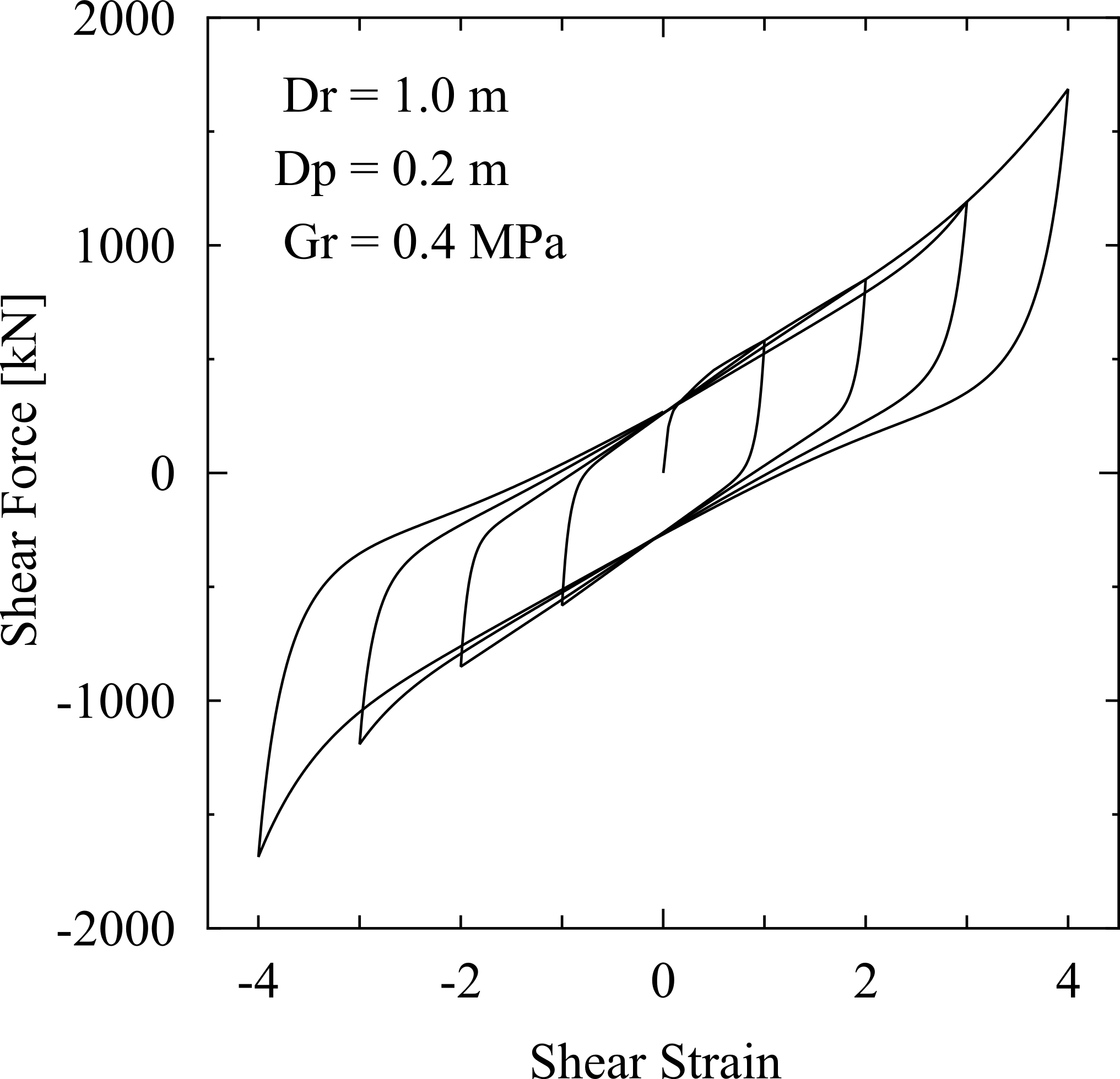
Fig. 3.1.8.95 Force-strain response of the KikuchiAikenLRB material
Note
The material uses SI units internally: the arguments must be given in m, m2 and N/m2.
$rs and $rf apply when the material is used in a multipleShearSpring (MSS) element. Recommended values are \(r_s = 1 / \sum_{i=0}^{n-1} \sin^2(\pi i / n)\) and \(r_f = 1 / \sum_{i=0}^{n-1} \sin(\pi i / n)\), where \(n\) is the number of springs, e.g. for \(n = 8\), \(r_s = 0.2500\) and \(r_f = 0.1989\).
Example:
The following example defines a lead-rubber bearing, in N and m units.
uniaxialMaterial KikuchiAikenLRB 1 1 0.5 0.2 0.39e6 0.0314 8.33e6 0.588e6 13.0
ops.uniaxialMaterial('KikuchiAikenLRB', 1, 1, 0.5, 0.2, 0.39e6, 0.0314, 8.33e6, 0.588e6, 13.0)
Code Developed by: Masaru Kikuchi