3.1.8.78. ImpactMaterial Material
- uniaxialMaterial ImpactMaterial $matTag $K1 $K2 $deltaY $gap
ops.uniaxialMaterial('ImpactMaterial', matTag, K1, K2, deltaY, gap)
Argument |
Type |
Description |
|---|---|---|
$matTag |
integer |
unique uniaxial material tag |
$K1 |
float |
initial stiffness |
$K2 |
float |
secondary stiffness |
$deltaY |
float |
yield displacement (negative) |
$gap |
float |
initial gap (negative) |
Discussion
This command is used to construct an ImpactMaterial material, a compression-only gap material for pounding, e.g. between bridge decks and abutments. It is a bilinear approximation of the Hertz contact model with nonlinear damping proposed by Muthukumar and DesRoches [1] [2], also used by Nielson [3].
The energy dissipated during an impact is
where \(k_h\) is the impact stiffness parameter (typically \(EA/L\), or 25,000 k/in3/2), \(n\) is typically 3/2, the exponent of the Hertz power rule, \(e\) is the coefficient of restitution, typically 0.6 to 0.8, and \(\delta_m\) is the maximum penetration during the impact. With the effective stiffness \(K_{eff} = k_h \sqrt{\delta_m}\) and the yield displacement \(\delta_y = a \, \delta_m\), where \(a\) is typically 0.1, the stiffnesses are chosen so that the bilinear model dissipates the same energy as the Hertz model:
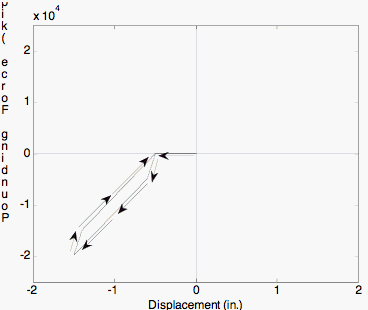
Fig. 3.1.8.83 Response during an impact
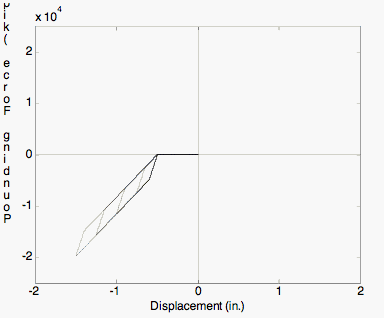
Fig. 3.1.8.84 Response for displacement cycles of increasing amplitude
Note
The material is compression-only: $deltaY and $gap are negative.
Impact is another name for this material.
Example:
The following example defines an impact material with stiffnesses of 1000.0 and 100.0, a yield displacement of -0.01, and a gap of -0.02.
uniaxialMaterial ImpactMaterial 1 1000.0 100.0 -0.01 -0.02
ops.uniaxialMaterial('ImpactMaterial', 1, 1000.0, 100.0, -0.01, -0.02)
Code Developed by: Mathew Dryden, UC Berkeley