3.1.8.83. ECC01 Material
- uniaxialMaterial ECC01 $matTag $sigt0 $epst0 $sigt1 $epst1 $epst2 $sigc0 $epsc0 $epsc1 $alphaT1 $alphaT2 $alphaC $alphaCU $betaT $betaC
ops.uniaxialMaterial('ECC01', matTag, sigt0, epst0, sigt1, epst1, epst2, sigc0, epsc0, epsc1, alphaT1, alphaT2, alphaC, alphaCU, betaT, betaC)
Argument |
Type |
Description |
|---|---|---|
$matTag |
integer |
unique uniaxial material tag |
$sigt0 |
float |
tensile cracking stress |
$epst0 |
float |
strain at the tensile cracking stress |
$sigt1 |
float |
peak tensile stress |
$epst1 |
float |
strain at the peak tensile stress |
$epst2 |
float |
ultimate tensile strain |
$sigc0 |
float |
compressive strength (negative) |
$epsc0 |
float |
strain at the compressive strength (negative) |
$epsc1 |
float |
ultimate compressive strain (negative) |
$alphaT1 |
float |
exponent of the unloading curve in the tensile strain hardening region |
$alphaT2 |
float |
exponent of the unloading curve in the tensile softening region |
$alphaC |
float |
exponent of the unloading curve in the compressive softening region |
$alphaCU |
float |
exponent of the compressive softening curve (1 for linear softening) |
$betaT |
float |
parameter determining the permanent strain in tension |
$betaC |
float |
parameter determining the permanent strain in compression |
Discussion
This command is used to construct an ECC01 material, a uniaxial model of engineered cementitious composites (ECC), highly ductile fiber-reinforced cement-based composites, after Han et al. [1]. Reloading in tension and compression is linear.
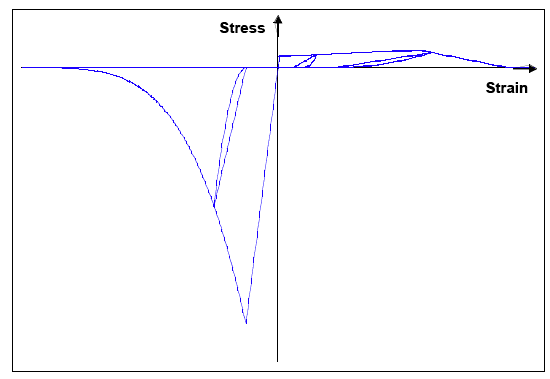
Fig. 3.1.8.91 ECC01 material
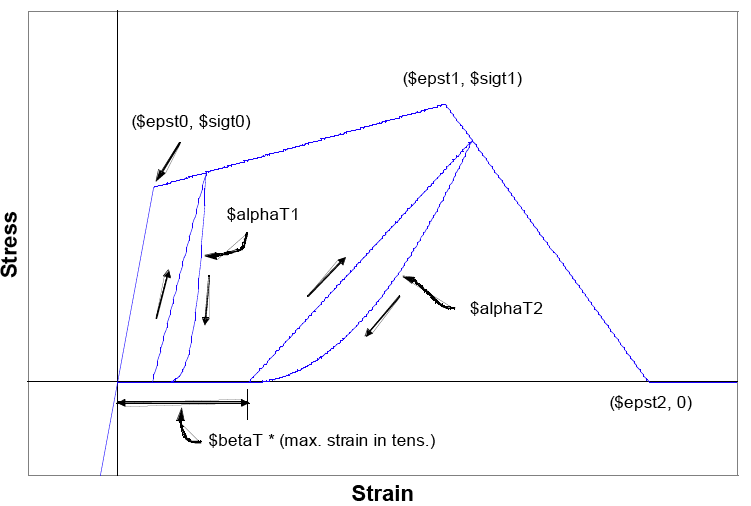
Fig. 3.1.8.92 Tensile response
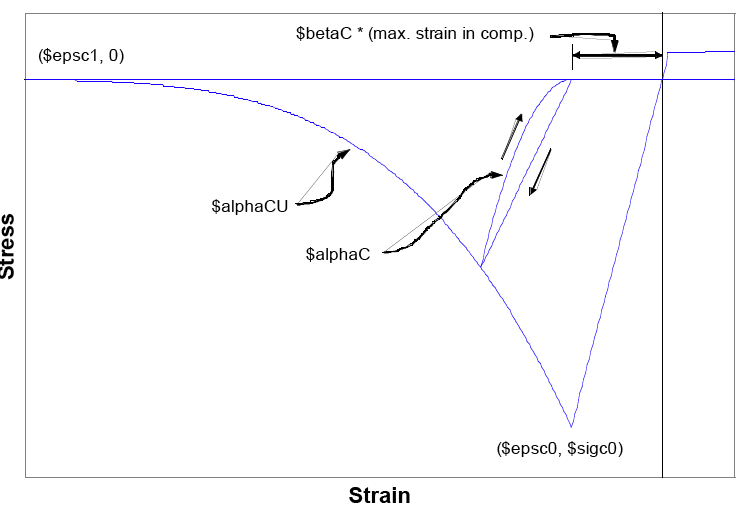
Fig. 3.1.8.93 Compressive response
Note
The compressive parameters are negative.
Example:
The following example defines an ECC01 material in MPa.
uniaxialMaterial ECC01 1 3.0 0.0001 4.0 0.03 0.05 -50.0 -0.003 -0.01 2.0 1.0 1.0 1.0 0.5 0.5
ops.uniaxialMaterial('ECC01', 1, 3.0, 0.0001, 4.0, 0.03, 0.05, -50.0, -0.003, -0.01, 2.0, 1.0, 1.0, 1.0, 0.5, 0.5)
Code Developed by: Won Lee and Sarah Billington, Stanford University