3.1.8.40. Pinching4 Material
- uniaxialMaterial Pinching4 $matTag $ePf1 $ePd1 $ePf2 $ePd2 $ePf3 $ePd3 $ePf4 $ePd4 <$eNf1 $eNd1 $eNf2 $eNd2 $eNf3 $eNd3 $eNf4 $eNd4> $rDispP $rForceP $uForceP <$rDispN $rForceN $uForceN> $gK1 $gK2 $gK3 $gK4 $gKLim $gD1 $gD2 $gD3 $gD4 $gDLim $gF1 $gF2 $gF3 $gF4 $gFLim $gE $dmgType
ops.uniaxialMaterial('Pinching4', matTag, ePf1, ePd1, ePf2, ePd2, ePf3, ePd3, ePf4, ePd4, <eNf1, eNd1, eNf2, eNd2, eNf3, eNd3, eNf4, eNd4>, rDispP, rForceP, uForceP, <rDispN, rForceN, uForceN>, gK1, gK2, gK3, gK4, gKLim, gD1, gD2, gD3, gD4, gDLim, gF1, gF2, gF3, gF4, gFLim, gE, dmgType)
Argument |
Type |
Description |
|---|---|---|
$matTag |
integer |
unique uniaxial material tag |
$ePf1 $ePf2 $ePf3 $ePf4 |
float |
force points of the positive response envelope |
$ePd1 $ePd2 $ePd3 $ePd4 |
float |
deformation points of the positive response envelope |
$eNf1 $eNf2 $eNf3 $eNf4 |
float |
force points of the negative response envelope (optional: see note 1) |
$eNd1 $eNd2 $eNd3 $eNd4 |
float |
deformation points of the negative response envelope (optional: see note 1) |
$rDispP |
float |
ratio of the deformation at which reloading occurs to the maximum historic deformation demand |
$rForceP |
float |
ratio of the force at which reloading begins to the force corresponding to the maximum historic deformation demand |
$uForceP |
float |
ratio of the strength developed on unloading from negative load to the maximum strength developed under monotonic loading |
$rDispN $rForceN $uForceN |
float |
as $rDispP, $rForceP and $uForceP, for the negative direction (optional: see note 1) |
$gK1 $gK2 $gK3 $gK4 $gKLim |
float |
parameters controlling the cyclic degradation of the unloading stiffness |
$gD1 $gD2 $gD3 $gD4 $gDLim |
float |
parameters controlling the cyclic degradation of the reloading stiffness |
$gF1 $gF2 $gF3 $gF4 $gFLim |
float |
parameters controlling the cyclic degradation of the strength |
$gE |
float |
maximum energy dissipation under cyclic loading, as a multiple of the energy dissipated under monotonic loading |
$dmgType |
string |
type of damage: cycle (damage depends on the displacement history) or energy (damage depends on the displacement history and the dissipated energy) |
Discussion
This command is used to construct a Pinching4 material, a uniaxial material that represents a pinched load-deformation response, and exhibits degradation under cyclic loading [1]. The response is defined by a multilinear envelope of four points in each direction, a trilinear unloading-reloading path that represents the pinching, and three damage rules that degrade the unloading stiffness, the reloading stiffness and the strength.
Each degraded quantity is its initial value times \((1 - \delta)\), where \(\delta\) is a damage index:
unloading stiffness: \(k_i = k_0 (1 - \delta k_i)\);
reloading stiffness: the deformation at which the reloading path reaches the envelope, \(d_{max,i} = d_{max,0} (1 + \delta d_i)\);
strength: \(f_{max,i} = f_{max,0} (1 - \delta f_i)\).
Each damage index is computed, e.g. for the unloading stiffness, as
where \(d_{max}\) is the larger of the maximum positive and negative deformation demands, and \(d_{ult}\) the larger of the deformations of the fourth envelope points. The second term depends on the type of damage:
energy: \(D = (E - E_{el}) / E_{cap}\), the hysteretic energy dissipated, less the elastic strain energy, divided by the energy capacity, \(E_{cap}\), which is $gE times the energy dissipated under monotonic loading;
cycle: \(D\) is the number of cycles.
The reloading stiffness and strength indices have the same form, with the \(g_D\) and \(g_F\) parameters.
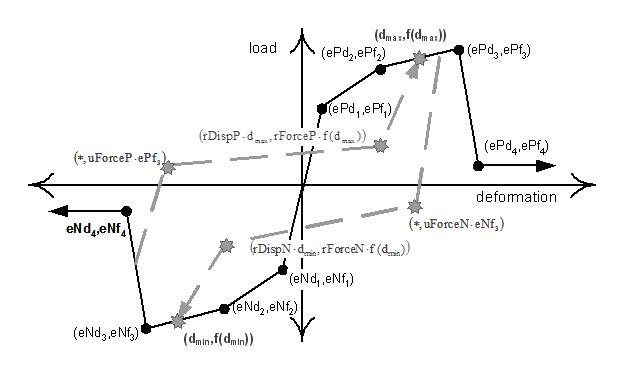
Fig. 3.1.8.56 Pinching4 material: envelope and unloading-reloading parameters
Note
The negative envelope and unloading-reloading parameters are optional, but must be given together: either 29 or 39 values follow the tag. If they are not given, the response is symmetric, and the negative values are those of the positive direction.
The negative envelope points are given as negative numbers.
The BarSlip material is built on this material.
Example:
The following example defines a symmetric Pinching4 material, with energy damage, then a material with the negative envelope given explicitly and cycle damage.
uniaxialMaterial Pinching4 1 100.0 0.01 150.0 0.03 180.0 0.06 50.0 0.10  0.5 0.25 0.05  1.0 0.2 0.3 0.2 0.9  0.5 0.5 2.0 2.0 0.5  1.0 0.0 1.0 1.0 0.9  10.0 energy
uniaxialMaterial Pinching4 2 100.0 0.01 150.0 0.03 180.0 0.06 50.0 0.10  -100.0 -0.01 -150.0 -0.03 -180.0 -0.06 -50.0 -0.10  0.5 0.25 0.05  0.5 0.25 0.05  1.0 0.2 0.3 0.2 0.9  0.5 0.5 2.0 2.0 0.5  1.0 0.0 1.0 1.0 0.9  10.0 cycle
ops.uniaxialMaterial('Pinching4', 1, 100.0, 0.01, 150.0, 0.03, 180.0, 0.06, 50.0, 0.10, 0.5, 0.25, 0.05, 1.0, 0.2, 0.3, 0.2, 0.9, 0.5, 0.5, 2.0, 2.0, 0.5, 1.0, 0.0, 1.0, 1.0, 0.9, 10.0, 'energy')
ops.uniaxialMaterial('Pinching4', 2, 100.0, 0.01, 150.0, 0.03, 180.0, 0.06, 50.0, 0.10, -100.0, -0.01, -150.0, -0.03, -180.0, -0.06, -50.0, -0.10, 0.5, 0.25, 0.05, 0.5, 0.25, 0.05, 1.0, 0.2, 0.3, 0.2, 0.9, 0.5, 0.5, 2.0, 2.0, 0.5, 1.0, 0.0, 1.0, 1.0, 0.9, 10.0, 'cycle')
Code Developed by: Nilanjan Mitra