3.1.8.74. BilinearOilDamper Material
- uniaxialMaterial BilinearOilDamper $matTag $K $Cd <$Fr $p> <$LGap> <$NM $RelTol $AbsTol $MaxHalf>
ops.uniaxialMaterial('BilinearOilDamper', matTag, K, Cd, <Fr, p>, <LGap>, <NM, RelTol, AbsTol, MaxHalf>)
Argument |
Type |
Description |
|---|---|---|
$matTag |
integer |
unique uniaxial material tag |
$K |
float |
elastic stiffness of the linear spring that represents the axial flexibility of the damper (brace and damper) |
$Cd |
float |
viscous damping coefficient before relief |
$Fr |
float |
relief load of the damper (optional: default = 1.0) |
$p |
float |
ratio of the post-relief to the initial damping coefficient (optional: default = 1.0, i.e. a linear oil damper) |
$LGap |
float |
gap length, e.g. due to the pin tolerance (optional: default = 0.0) |
$NM |
integer |
adaptive integration method: 1 Dormand-Prince 5(4), 2 adaptive finite difference (optional: default = 1) |
$RelTol |
float |
relative error tolerance (optional: default = 1.0e-6) |
$AbsTol |
float |
absolute error tolerance (optional: default = 1.0e-10) |
$MaxHalf |
integer |
maximum number of sub-step halvings in a step (optional: default = 15) |
Discussion
This command is used to construct a BilinearOilDamper material, which simulates the hysteretic response of a bilinear oil damper with a relief valve: a linear spring in series with a dashpot whose damping coefficient drops from \(C_d\) to \(p \, C_d\) once the force reaches the relief load \(F_r\). The constitutive equations are solved with an adaptive numerical algorithm [1] [2].
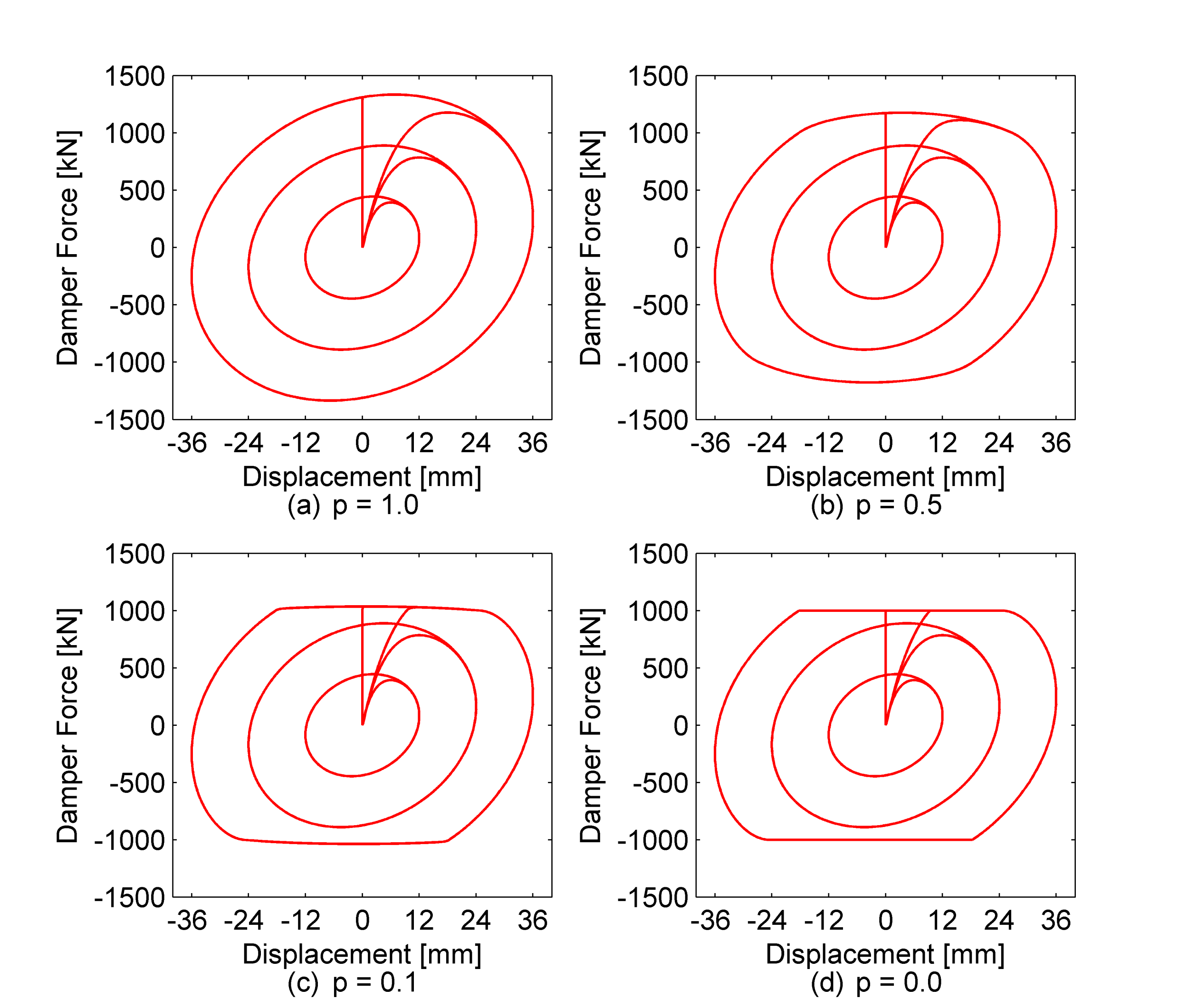
Fig. 3.1.8.77 Response for various post-relief damping coefficient ratios: p = 1.0, 0.5, 0.1 and 0.0 (K = 200 kN/mm, Cd = 6 kN/(mm/s), Fr = 1000 kN)
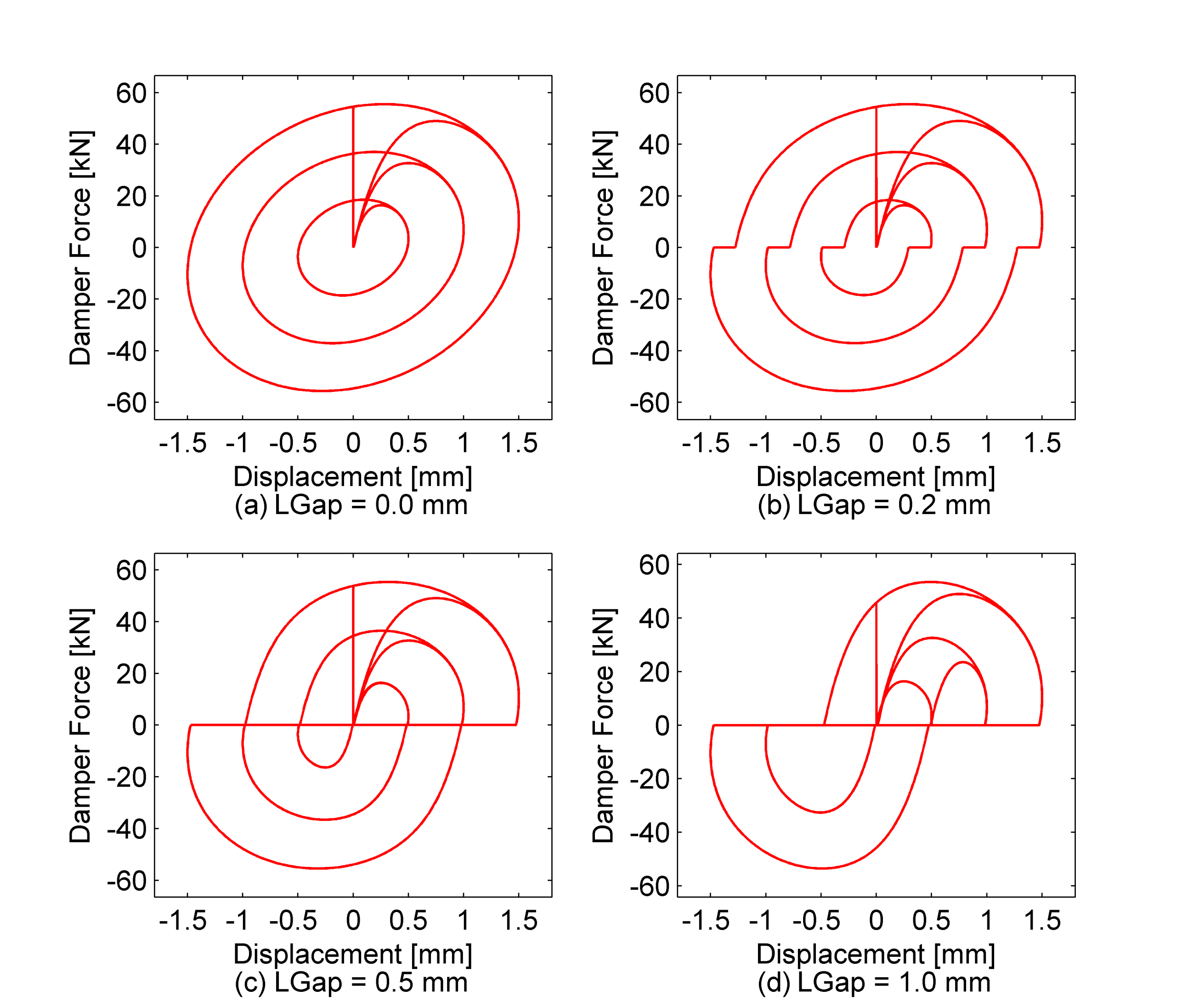
Fig. 3.1.8.78 Response for various gap lengths: 0.0, 0.2, 0.5 and 1.0 mm
Note
The optional arguments can be given as: none; $Fr $p; $Fr $p $LGap; or all of $Fr $p $LGap $NM $RelTol $AbsTol $MaxHalf.
Example:
The following example defines an oil damper, in kN and mm units, with a stiffness of 200 kN/mm, a damping coefficient of 6 kN/(mm/s), a relief load of 1000 kN and a post-relief ratio of 0.1, then the same with a 0.5 mm gap.
uniaxialMaterial BilinearOilDamper 1 200.0 6.0 1000.0 0.1
uniaxialMaterial BilinearOilDamper 2 200.0 6.0 1000.0 0.1 0.5
ops.uniaxialMaterial('BilinearOilDamper', 1, 200.0, 6.0, 1000.0, 0.1)
ops.uniaxialMaterial('BilinearOilDamper', 2, 200.0, 6.0, 1000.0, 0.1, 0.5)
Code Developed by: Sarven Akcelyan and Dimitrios G. Lignos, McGill University